


Why Your Cat Is Still Escaping: The 8 Critical Installation Mistakes

Why Your Cat Is Still Escaping: The 8 Critical Installation Mistakes
Installing Oscillot Correctly is Everything—Here's How to Diagnose and Fix Installation Failures
You've installed an Oscillot system. Your cat should be contained. Yet they still seem to be testing the boundaries—or worse, actually escaping. Before concluding that the system failed or that your cat is simply ineducable, understand this critical fact: the vast majority of escape incidents stem from installation errors rather than product failures. A perfectly-functioning Oscillot system installed incorrectly might as well be a traditional fence—and an incorrectly-installed system can create more problems than the original fencing. This comprehensive guide explores eight critical installation mistakes, how to identify them, and how to correct them before your cat escapes.
Escape vs. Boundary Testing: The Critical Distinction
Before diagnosing installation errors, distinguish between genuine escape and boundary testing:
- Boundary testing: Cat approaches fence, encounters paddle, experiences gentle rotational feedback, retreats. This is normal and actually indicates system success—cat is learning boundaries.
- Escape attempt: Cat successfully crosses fence boundary to outside area. This indicates installation failure.
Some property owners mistake normal boundary testing for escape attempts, leading to unnecessary problem-solving. A properly-installed Oscillot system with any escape attempts indicates a specific installation error. Use the diagnostic framework below to identify and correct it.
Mistake #1: Insufficient Fence Height
The Problem
Oscillot functions optimally on fences already achieving minimum 1.8m height. If your fence is significantly below this threshold (1.5m or less), even a properly installed Oscillot system may not prevent athletic escape artists.
Why This Happens
- Property owners assume Oscillot "adds height" to fences
- The system actually prevents vertical escape by removing grip surfaces on existing fences
- If the underlying fence is too low, even without climbing options, some athletic cats can jump over
- Downslope terrain can effectively reduce fence height relative to where cats jump from
How to Diagnose Height Issues
- Measure actual fence height from ground to fence top with tape measure (measure at multiple points around property)
- Note ground elevation differences—cats jump from the lowest points
- Observe escape attempt carefully: does cat jump cleanly over paddle assembly, or does it never reach the top?
The Solution
- Verify actual fence height (measure from ground to top edge)—not assumed height
- On shorter fences, install supplementary height extensions BEFORE adding Oscillot
- Consider terrain elevation variation; measure height at ground level where cats actually jump from
- Add angled extensions on top of fence to increase effective height if fence is marginally inadequate
Mistake #2: Improper Bracket Spacing
The Problem
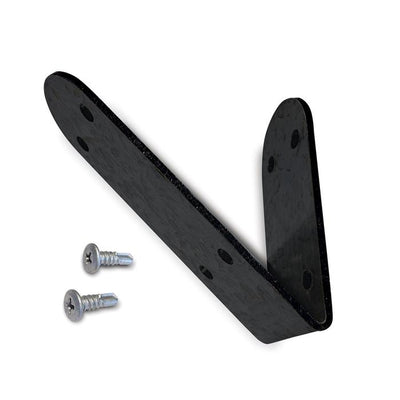
Brackets hold the entire paddle system in place and must be positioned correctly. Spacing brackets too far apart (more than 30cm) creates flex and lateral movement in the paddle assembly, allowing cats to find grip points or create instability they can exploit.
How This Happens
- Installers attempting to reduce component costs by using fewer brackets
- Misunderstanding bracket function (treating them as decorative rather than structural support)
- Not accounting for fence material variability—timber requires tighter spacing than metal
- DIY installers not realizing spacing tolerance is critical for system function
How to Diagnose Bracket Issues
- Visual inspection: Look at paddle assembly and assess if it appears to flex or move
- Physical test: Push on paddle assembly at midpoint between brackets; any lateral movement exceeding 1cm indicates insufficient spacing
- Paddle rotation: If paddle resists rotation at certain points but not others, uneven bracket spacing likely causes uneven bearing support
- Cat behavior: Cats attacking same fence section repeatedly suggests that section has exploitable instability
The Solution
- Follow installation guidelines precisely: maximum 20cm spacing on timber, 25cm on metal/colorbond
- Install ADDITIONAL Brackets beyond kit specifications if fence material is particularly flexible
- Test bracket tightness after installation; any detectable movement indicates need for additional brackets
- Purchase additional brackets (€3.00 each) and reinstall with proper spacing
Mistake #3: Inadequate Post Kit Assembly
The Problem
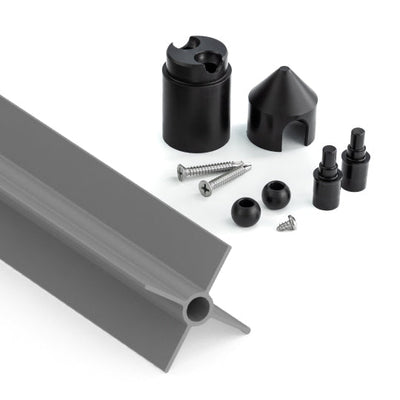
Dual Knuckle Post Kits provide the bearing support that allows paddles to rotate freely. Improper assembly or insufficient fastening prevents smooth rotation, causing paddles to stick or create rough surfaces cats can grip.
Assembly Issues
- Not tightening fastening hardware sufficiently during assembly
- Misaligning bearing components during installation
- Using non-Oscillot components to replace or supplement bearing assemblies
- Failing to verify bearing function before allowing cats into space
How to Diagnose Post Kit Problems
- Manual rotation test: Gently rotate every paddle by hand—compare resistance across all paddles
- Grinding or roughness: Any grinding, clicking, or rough sensation indicates bearing misalignment
- Stiffness variation: Some paddles rotating smoothly while others are stiff indicates assembly inconsistency
- Visible misalignment: Inspect post kit assemblies; bearing housings should be parallel to ground
The Solution
- Assemble all Post Kit components according to provided specifications precisely
- Verify bearing rotation by hand before cats are introduced to the space
- Use ONLY Oscillot-approved Axle Pins and fastening hardware; substitutions compromise bearing function
- Order Dual Knuckle Post Kit replacements (€15.99) if assembly cannot be corrected
- Test paddle rotation monthly to ensure continued smooth operation
Mistake #4: Missing or Inadequate Gate Coverage
The Problem
Gates are the most common escape route in supposedly "contained" spaces. Even a perfectly installed perimeter system becomes completely useless if the gate lacks paddle coverage or has structural gaps.
Why Gates Become Escape Routes
- Installers treat gates as secondary to fence coverage—they're not
- Gate frames often don't accommodate paddle assembly mounting without modification
- Gap at gate threshold may be overlooked as "too small for cats to escape"
- Gate paddle coverage is treated as optional rather than critical
How to Diagnose Gate Coverage Problems
- Visual inspection of gate: Can you see through gaps around gate frame? If yes, cat might exploit those gaps
- Gap measurement: Measure clearance under gate and around frame—any gap exceeding 2cm is problematic
- Paddle coverage: Is there paddle coverage across gate opening? This is non-negotiable
- Escape behavior: Do escapes occur specifically at gate area? This indicates gate is the weak point
The Solution
- Install arched gate solutions extending paddle coverage completely across gate openings
- Ensure gate frame structure accommodates paddle assembly mounting—modify frame if necessary
- Test gate paddle assembly thoroughly before declaring system complete—cats will exploit gate-specific weakness
- For complex gate situations, consult professional installation partners to prevent costly gate-related failures
Mistake #5: Ignoring Climbing Aids and Jumping Assists
The Problem
Even with perfect paddle installation, trees, structures, or tall vegetation within 1.5m of the fence line can serve as climbing aids or jumping assists, allowing cats to reach fence height more easily.
How Climbing Aids Become Escape Routes
- Tree branches provide climbing routes to fence height
- Tall vegetation creates jumping platforms
- Structures (sheds, decks) provide elevation advantage
- Fence-adjacent plants touching fence surface facilitate climbing
How to Diagnose Climbing Aids
- 3-foot rule check: Are there climbing aids within 90cm of fence line? This violates containment principle
- Cat observation: Do your cats climb or jump toward specific fence sections? These sections have climbing aids
- Visual path analysis: Can a cat reach fence height by climbing nearby vegetation or jumping from structures?
The Solution
- Identify and remove or trim climbing aids within 1.5m of fence perimeter
- Trim tree branches that provide accessible routes to fence height
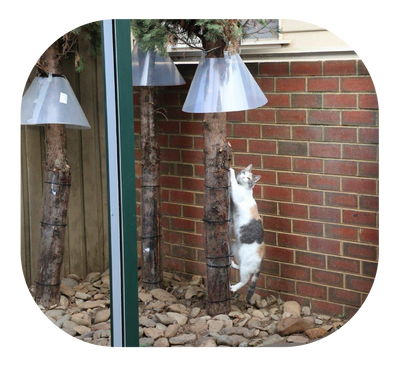
- Install Tree Guards (€25.99 each) on trees that cannot be removed
- Remove fence-adjacent plants that facilitate climbing
- Maintain "3-foot clear zone" principle indefinitely—new vegetation grows; trim regularly
Mistake #6: Misaligned Paddle Orientation
The Problem
Paddles must face outward and maintain consistent angle relative to ground plane. Misaligned paddles (rotated inward, tilted at improper angles, or facing partially down) create surfaces cats can grip or use as jumping assists.
Orientation Misalignment Issues
- Rotated inward toward fence (facing wrong direction)—creates surface cats can grip
- Tilted at improper angles relative to horizontal—creates edge cats can use for leverage
- Angled downward instead of horizontal—provides jumping platform
- Curved fence sections where paddle angle varies around curve—creates exploitable variation
How to Diagnose Orientation Problems
- Visual inspection: Do all paddles face outward consistently? Do they appear to be at same angle relative to ground?
- Side-by-side comparison: Look at three sequential paddles; they should appear identical in orientation
- Rotation function: Verify every paddle rotates smoothly in same direction—misoriented paddles may rotate differently
The Solution
- Verify every paddle face orientation before activating space for cats—this is non-negotiable
- On curved sections, ensure paddles are positioned perpendicular to fence plane (at consistent rotation angle around curves)
- Use visual reference markers if available—ensure all markers point same direction
- Reinstall misoriented paddles if orientation cannot be corrected by adjustment
Mistake #7: Insufficient Coverage at Fence Top
The Problem
Some installations leave gaps at fence corners, gate connections, or transitions between fence sections. These gaps—even if only a few centimeters—are precisely where escape-motivated cats focus their efforts.
Gap Creation Causes
- Not accounting for fence profile variations (beveled tops, rounded edges)
- Failing to install supplementary paddle coverage at section transitions
- Using incompatible paddle materials that don't transition smoothly between sections
- Gate openings left with incomplete paddle coverage
How to Diagnose Coverage Gaps
- Visual inspection: Walk entire fence perimeter looking for any breaks in paddle coverage
- Gap measurement: Any gap exceeding 3cm is potential escape route—measure gaps carefully
- Transition areas: Inspect corners, gates, and section transitions specifically—these are gap-prone areas
- Escape location: Do your cats attempt escape at specific fence sections? These likely have gaps
The Solution
- Install continuous paddle coverage with zero gaps at transitions between fence sections
- At gate openings, extend paddle coverage completely across gate threshold
- Use supplementary paddle segments (€24.00) to bridge transition areas
- Install additional paddles at beveled or curved fence tops to maintain continuous coverage
Mistake #8: Failing to Maintain Bearing Rotation
The Problem
Over time, debris, rust, corrosion, or wear can reduce bearing smoothness. Stiff or poorly rotating bearings create inconsistent resistance that clever cats learn to exploit.
Bearing Degradation Causes
- Debris accumulation on bearing assemblies (leaves, dirt, sand)
- Rust or corrosion from moisture, salt spray, or poor drainage
- Wear of bearing components (Axle Pins, ball bearings) from extended use
- Lubrication breakdown or absence of appropriate maintenance
How to Diagnose Bearing Problems
- Manual rotation test: Gently rotate paddles monthly—they should move freely without resistance
- Sound analysis: Any grinding, clicking, or rough noise indicates bearing problem
- Resistance variation: Some paddles stiff, others smooth—indicates wear or corrosion at different stages
- Debris observation: See accumulated material around bearing assemblies? This indicates maintenance deficit
The Solution
- Establish monthly bearing rotation checks (manually rotate paddles to verify smooth operation)
- Remove debris immediately after storms or heavy wind events
- Apply appropriate lubricants (silicone-based ONLY; never heavy oils which attract dirt) if bearings become stiff
- Replace worn Axle Pins (€2.79+) or bearing components before degradation becomes severe
The Diagnostic Flowchart: Identifying Your Specific Installation Error
Follow This Systematic Diagnosis Process:
- Are cats actually escaping, or just testing boundaries? → Boundary testing is normal; true escapes indicate installation error
- Check fence height → Below 1.8m? Install height extension
- Check bracket tightness → Any lateral movement exceeding 1cm? Add additional brackets
- Verify bearing rotation → Can you manually rotate all paddles smoothly? No? Realign bearing assembly or replace Axle Pins
- Inspect paddle orientation → All paddles facing outward at consistent angle? Realign any misoriented sections
- Identify climbing aids → Trees, structures within 1.5m of fence? Remove or install Tree Guards
- Check gate coverage → Can cats exploit gate opening? Install arched gate solution or paddle extension
- Visual fence inspection → Any gaps at transitions? Install supplementary paddle coverage
Getting Professional Diagnostics and Support
If you've checked all eight common mistakes and escapes continue, contact Oscillot support with:
- Photographs of your installation (fence height, bracket spacing, gate coverage, surrounding structures)
- Description of exactly how your cats are escaping
- Videos of escape attempts if possible
- Installation timeline and any recent changes to property or fence
Contact Oscillot Installation Support
Most escape incidents resolved through Oscillot support reveal a simple installation adjustment—usually bracket spacing, gate coverage, or nearby climbing aids. Proper diagnosis and correction typically resolves the issue within days, not weeks.
The Essential Truth About Oscillot Installation Failures
Your Oscillot system is engineered to be absolutely escape-proof. Every installation failure is traceable to one of these eight critical mistakes. Take systematic diagnostics seriously, correct identified errors, and verify your system with comprehensive testing before declaring it successful. A properly-installed Oscillot system provides zero-failure containment. An incorrectly-installed Oscillot system is no better than traditional fencing—worse, actually, because you've invested time and money in installation.
Your Oscillot system works. If your cat is escaping, there's a correctable installation detail causing the failure—not a product defect.